
Mosquito Control Systems in Sullivan’s Island, SC2026-08-25T03:06:40+00:00

Mosquito Control Systems on Sullivan’s Island, SC

Sullivan’s Island has a mosquito problem that most of Charleston doesn’t. You have salt marsh on one side and ocean on the other, and the marsh behind the Stations is a nursery. When a king tide floods the pluff mud or a summer storm dumps three inches overnight, salt marsh mosquitoes hatch in enormous numbers a few days later and ride the evening breeze straight into your yard. Charleston County’s truck spraying helps, but it passes through once, and the marsh keeps producing.

Knockout Mosquito installs automatic misting systems and runs recurring fogging service for homes across Sullivan’s Island, SC — from the Fort Moultrie end through the Middle Street business district and out toward Breach Inlet. We have been doing this in the Lowcountry long enough to know that an island yard is not a mainland subdivision yard. The bugs are different, the breeding sources are different, and the hardware has to survive salt air.

If you are tired of giving up your porch at 7 p.m., call 843-270-1729 for a free property walk-through. No charge, no pressure, and we will tell you honestly whether you need a full system or just seasonal fogging.

Why Sullivan’s Island Yards Get Hit Harder

The island’s geography works against you in three specific ways.

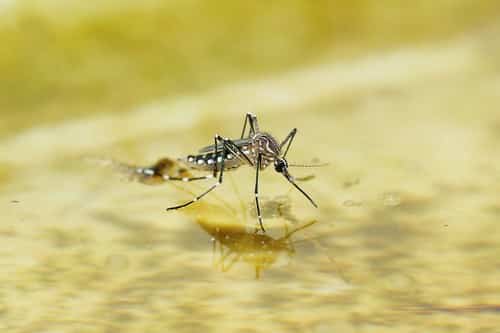
The back-island salt marsh breeds in pulses. The black salt marsh mosquito (Aedes taeniorhynchus) lays eggs in damp marsh soil that stay dormant until water covers them. King tides in September and October, storm surge, and heavy rain all trigger a hatch at once. That is why the island can be tolerable for two weeks and then unbearable overnight. These are strong fliers, capable of a mile or more, so a house on Middle Street is not out of range of the marsh behind it.

Container breeding happens in your own yard. The Asian tiger mosquito (Aedes albopictus) does not need the marsh. It breeds in a saucer under a potted fern, a clogged gutter on a 1930s cottage, a boat cover, a kayak left upright, the tray under an outdoor shower. This is the one that bites all day, and it rarely travels more than a few hundred feet from where it hatched. If you are getting bitten at 2 p.m., the source is almost certainly on your property or your neighbor’s.

Elevated houses create perfect harborage. Most of the island is built up on pilings, and the shaded, humid space underneath — plus the dense wax myrtle, palmetto, and live oak that shelters these lots from the wind — is exactly where adult mosquitoes rest during the heat of the day. That is the zone our backyard mosquito control systems target.

And then there are the no-see-ums. Biting midges come off the marsh at dawn and dusk and go right through standard screen. They are small enough that most homeowners assume nothing works on them. Our misting systems can be tuned for midges, which is one of the more common reasons islanders call us in the first place.

Contact Us


    Mosquito Fogging

    We offer monthly and weekly mosquito fogging services for residences throughout the Charleston SC area. Enjoy the outdoors, bug free!

    Mosquito Misting System

    Our mosquito misting systems in charleston SC provide year-round protection from mosquitos and other biting insects around your property.

    Mosquito Misting Systems for Sullivan’s Island Homes

    A misting system is permanent infrastructure for your yard. We run flexible tubing along your fence line, under the deck, through the landscape beds, and around the perimeter of the house, with nozzles placed where mosquitoes actually rest rather than in a decorative ring. A pump and reservoir sit in an out-of-the-way spot, usually under the house or beside the outdoor shower.

    The system runs on a timer at dawn and dusk, when salt marsh mosquitoes and midges are most active, and you can hit a remote or an app before a cookout to knock down anything hanging around. Each cycle takes under a minute.

    What we do differently on the island:

    • Corrosion-rated fittings and stainless nozzles. Salt air eats standard brass hardware. We spec accordingly, and we have replaced enough failed budget installs on Sullivan’s Island to know it matters.
    • Placement for elevated homes. Under-house zones, piling bases, and the shaded side yard get coverage, because that is where the resting population sits.
    • Marsh-facing coverage. If your lot backs to the marsh or a creek, that edge gets denser nozzle placement than the street side.
    • Concentrate options. Botanical formulations are available if you have a pollinator garden, chickens, koi, or just prefer them. We will walk you through the tradeoff honestly, since botanicals need more frequent cycles.
    • Refill and service on a schedule. We monitor the tank, refill it, and check nozzles. You are not climbing under the house with a flashlight.

    Most island installs take a single day. Older cottages with tight crawl spaces or heavy landscaping sometimes take longer, and we will tell you that during the walk-through instead of on install day. Learn more about our mosquito misting systems.

    Mosquito Fogging Service on Sullivan’s Island

    Not every property needs a permanent system. Fogging is a good fit if you are renting, if you are in a historic home where you would rather not run tubing, or if you just want coverage through the worst of the season.

    A technician treats the resting sites — the undersides of leaves, dense shrubs, fence lines, under decks and stairs, the shaded space beneath elevated homes — with a barrier application that kills adults on contact and keeps working for roughly three weeks. We also treat standing water with larvicide where we find it, which is the part most companies skip and the part that actually reduces next month’s population.

    • Every three weeks, April through November. The standard for island homes with heavy marsh exposure.
    • Monthly. Works for lots further from the marsh edge or with less vegetation.
    • One-time event treatment. Weddings at the lighthouse, oyster roasts, graduation parties, rehearsal dinners. Book about 48 hours ahead so the application has time to settle.

    See our mosquito fogging service details.

    Ticks, No-See-Ums, and What Else We Handle

    Sullivan’s Island is not just mosquitoes. The maritime forest and accreted land between the houses and the beach hold a real tick population, and dogs that run the dune line bring them home. Our barrier treatments and misting systems both suppress ticks in the same zones where they wait for a host: tall grass edges, leaf litter, and shaded property borders.

    Health context, briefly. Mosquitoes in South Carolina can carry West Nile virus and eastern equine encephalitis, and travel-associated dengue and chikungunya cases turn up in the state most years. Ticks here can transmit Lyme disease, ehrlichiosis, Rocky Mountain spotted fever, and alpha-gal syndrome, the red meat allergy that Lowcountry residents deal with more than most parts of the country. Heartworm in dogs is mosquito-transmitted and is a year-round risk in this climate. Control is not only about comfort.

    Areas We Serve on Sullivan’s Island

    • All Stations, from Station 9 through Station 32½
    • Middle Street, Jasper Boulevard, Atlantic Avenue, and I’On Avenue
    • The Fort Moultrie and Sullivan’s Island Lighthouse end
    • Marsh-front lots along the Intracoastal side
    • Properties near Breach Inlet and the Isle of Palms Connector

    We also serve Isle of Palms, Mount Pleasant, Daniel Island, Downtown Charleston, James Island, Folly Beach, Kiawah, Seabrook, and Johns Island. Crossing the Ben Sawyer Bridge is a normal part of our week, so island service calls do not get deprioritized. View our full service area.

    When to Start, and Why Earlier Is Cheaper

    March and early April are the right time. Overwintering eggs and larvae are still in the marsh and in the containers around your yard, and adult numbers are low. Knocking the population down before it compounds means the rest of the season takes less product and less effort.

    Starting in July still works. It just means the first month is catch-up. Plenty of island homeowners run their systems year-round, because a warm week in February on Sullivan’s Island will absolutely produce mosquitoes.

    Call 843-270-1729 for a free Sullivan’s Island property assessment. We will walk your lot, find the breeding sources you did not know about, tell you where the pressure is coming from, and quote a system or a service schedule. It takes about twenty minutes, and there is no obligation.

    Testimonials

    Our Blog on Mosquito Control Systems

    A single mosquito bite can spread illnesses such as West Nile Virus, Encephalitis, Malaria, Chikungunya and even Heartworm in pets. Ticks are also a threat and can spread Lyme disease, Erlichiosis, and Rocky Mountain Spotted Fever. To find out more about how to control these pests and to protect your family, read our blog.

    .

    No Contracts, No Hassle, No Worries!

    Sullivan’s Island Mosquito Control FAQs

    Why are mosquitoes so bad on Sullivan’s Island?

    The salt marsh behind the island is a breeding ground for the black salt marsh mosquito, which lays eggs in damp soil that hatch in large synchronized batches whenever a king tide, storm surge, or heavy rain floods the marsh. These mosquitoes fly a mile or more, so nearly every address on Sullivan’s Island is within range. Add container-breeding Asian tiger mosquitoes in yards and biting midges coming off the marsh, and the pressure is higher than in most mainland Charleston neighborhoods.

    Does Charleston County mosquito control already spray Sullivan’s Island?

    Charleston County Mosquito Control conducts surveillance and area-wide spraying in the region, which temporarily reduces adult mosquitoes along the route. It is not a substitute for property-level treatment. County spraying does not treat the resting sites in your landscaping, does not larvicide standing water on your lot, and does not run the evening again after a marsh hatch. A misting system or recurring fogging service covers that gap.

    How much does a mosquito misting system cost on Sullivan’s Island?

    Cost depends on yard size, perimeter length, how much landscaping needs coverage, and whether the home is elevated. Larger marsh-front lots require more tubing and more nozzles than a compact interior lot. Knockout quotes after walking the property so the number reflects the actual install. The assessment is free. Call 843-270-1729.

    Will a misting system work on no-see-ums and sand gnats?

    Yes, with the right setup. Biting midges are smaller and more persistent than mosquitoes and require closer nozzle spacing and a concentrate rated for midges. A system designed only for mosquitoes often underperforms on no-see-ums, so mention midges during the property assessment and the system will be designed for them from the start.

    Is mosquito misting safe around kids, dogs, and the marsh?

    Knockout uses EPA-registered products applied at label rates, and systems run at dawn and dusk when children and pets are typically indoors. Botanical concentrates are available on request. Because Sullivan’s Island lots often sit near sensitive marsh habitat, nozzle placement and cycle timing are set to keep application on the property and away from open water. Specific products and reentry guidance are reviewed with each homeowner before installation.

    How often should I fog my yard on Sullivan’s Island?

    Every three weeks is the standard for island properties, particularly marsh-facing lots. Monthly service works for homes further from the marsh edge with less dense vegetation. After a king tide or heavy storm, an additional treatment a few days later, timed to the hatch, makes a noticeable difference.

    When is mosquito season on Sullivan’s Island, SC?

    Mosquito season on Sullivan’s Island runs roughly March through November, with the heaviest pressure from June through October. Because Charleston winters are mild, warm spells in February can produce active mosquitoes, which is why many island homeowners run their misting systems year-round instead of winterizing them.

    Will salt air ruin a mosquito misting system?

    Salt air corrodes standard fittings quickly, which is why budget systems fail on barrier islands. Knockout installs corrosion-rated hardware and stainless nozzles, and service visits include checking for salt buildup and clogged tips. An existing failing system from another installer can often be evaluated for retrofit.

    Can you treat for a wedding or party on Sullivan’s Island?

    Yes. One-time event fogging is one of the most requested island services, covering weddings near the lighthouse, oyster roasts, rehearsal dinners, and beach house gatherings. Book roughly 48 hours before the event so the application has time to settle and dry.

    Do you install misting systems on historic or elevated homes?

    Yes. Elevated homes are common on Sullivan’s Island, and the shaded space underneath is one of the most important zones to cover because adult mosquitoes rest there during the day. On older cottages, tubing is routed discreetly along existing lines such as fence rails, deck framing, and landscape beds so the installation stays visually unobtrusive.

    How long does mosquito misting system installation take?

    Most Sullivan’s Island installations are completed in a single day. Properties with tight crawl spaces, heavy landscaping, or unusually long perimeters can require a second day, which is identified during the free property assessment rather than on installation day.

    What areas near Sullivan’s Island do you serve?

    Along with the full island from Station 9 through Station 32½, Knockout Mosquito serves Isle of Palms, Mount Pleasant, Daniel Island, Downtown Charleston, James Island, Folly Beach, Johns Island, Kiawah, and Seabrook.